About Viola
Click here to download the full CV.
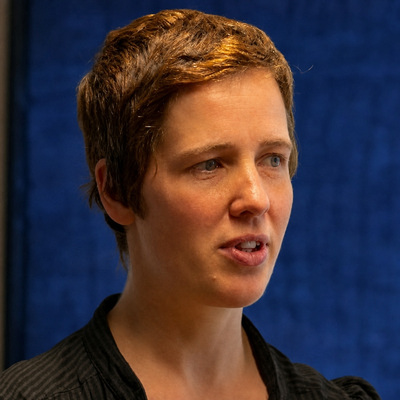
Viola Priesemann is a physicist and neuroscientist at the Max Planck Institute for Dynamics and Self-Organization, Göttingen. After research projects at the Ecole Normale Superieure Paris (France) and the Caltech (USA), she obtained her PhD at the MPI for Brain Research and the University of Frankfurt. As postdoc and Fellow at the Bernstein Center Göttingen she applied for an independent Max Planck Research Group, which started in 2017 at the MPI in Göttingen. She studies self-organization and learning in living and artificial networks, illuminating the basic mechanisms that shape collective information processing. Since the start of the COVID-19 pandemic, she investigated the spread of SARS-CoV-2, quantified the effectiveness of interventions, and derived containment strategies. Viola Priesemann coordinated several position and overview papers on the COVID-19 pandemic and is member of the advisory board of the German government. Her work has been recognized by several awards, including the Communitas Award of the Max-Planck-Society, the “Niedersächsische Wissenschaftspreis” and the Dannie-Heineman-Award. She is member of the Cluster of Excellence “Multiscale Bioimaging”, the Campus Institute for Data Science, the Max Planck - University of Toronto Centre for Neural Science and Technology, and of “Die Junge Akademie”.
Research Positions
| Date | Position |
|---|---|
| since 2022 | Professor (W3) Faculty of Physics, University Göttingen |
| since 2016 | MPRG Group Leader (W2) MPI for Dynamics and Self-Organization Göttingen |
| 2014 - 2016 | Bernstein Fellow & Group Leader Bernstein Center Göttingen |
| 2013 - 2014 | PostDoc with Theo Geisel at the MPI for Dynamics and Self-Organization Göttingen |
Education
| Date | Institution |
|---|---|
| 23.09.2013 | PhD in Physics (Dr. phil. nat.) “Subsampling in Critical Systems” Max Planck Institute for Brain Research, Frankfurt, Germany Faculty of Physics, Goethe University Frankfurt, Germany |
| 2010 | Summer Course “Neural Systems and Behavior”Marine Biology Laboratories Woods Hole, MA, USA funded by Thomas B. Grave and Elizabeth F. Grave Scholarship |
| 2008 - 2009 | École Normale Supérieure, Paris with Christian Machens |
| 2006 - 2007 | Diploma Thesis Max Planck Institute for Brain Research, Frankfurt, Germany Department of Wolf Singer |
| 2001 - 2008 | Diploma (Master) in Physics Technical University Darmstadt, Germany |
Honors & Awards
| Date | Award |
|---|---|
| 2026 | Teaching Award, Faculty of Physics, Göttingen |
| 2025 - | External Faculty, Complexity Hub Vienna, Austria |
| 2024 - 2025 | Präsidium, “Die Junge Akademie” |
| 2024 | Young Scientist Award for Socio- and Econophysics, DPG |
| 2023 | Member, Göttingen Academy of Sciences and Humanities |
| 2022 | Lise-Meitner-Lecture, German Physical Society & Austrian Physical Society (DPG & ÖPG) |
| 2022 | Arthur-Burkhardt-Award |
| 2022 | Minerva Award, Juelich |
| 2022 | Offer, Director Position, Helmholtz Center Munich |
| 2021 | Wissenschaftspreis Niedersachsen |
| 2021 | Dannie-Heineman-Award of the Göttingen Academy of Sciences and Humanities |
| 2021 | Member, “Expertengremium” on COVID-19 of the Federal Government of Germany |
| 2021 | Medaille für naturwissenschaftliche Publizistik of the German Physical Society |
| 2021 | Offer of a W3 Professorship (Ruf): Department of Physics, University of Göttingen |
| 2021 | Member of "Die Junge Akademie" |
| 2021 | Communitas-Award of the Max Planck Society |
| 2020 | Offer of a W3 Professorship (Ruf): Department of Physics, University of Heidelberg (declined) |
| 2020 | Our paper is one of the Max Planck Scientific Highlights 2020 |
| 2020 | Initiator and author of several position papers on COVID-19, e.g. together with the Leopoldina |
| 2015 - 2020 | Fellow of the Schiemann Kolleg of the Max Planck Society |
| 2014 & 2015 | Chair of the Computational Neuroscience Social at the Annual Meeting of the SfN |
Research Initiatives, Institutes & Consortia
We are members or supporters of the following research initiatives, institutes and consortia:
- Bernstein Network Computational Neuroscience
- CAIMed – Lower Saxony Center for Artificial Intelligence and Causal Methods in Medicine
- Campus Institute Data Science (CIDAS)
- CIDAS Section Complexity, Information, Cognition, Society (CICS)
- Deutsche Physikalische Gesellschaft (DPG)
- Die Junge Akademie
- Else Kröner Fresenius Center for Optogenetic Therapies (EKFZ)
- Faculty of Physics, University of Göttingen
- Federation of European Neuroscience Societies (FENS)
- Georg-August University School of Science (GAUSS)
- Gesellschaft für wissenschaftliche Datenverarbeitung Göttingen (GWDG)
- Göttingen Academy of Sciences and Humanities in Lower Saxony
- Göttingen Graduate Center for Neurosciences, Biophysics, and Molecular Biosciences (GGNB)
- IMPRS for Neurosciences
- infoXpand
- Max Planck Artificial Intelligence Network (MP-AIX)
- Max Planck Institute for Dynamics and Self-Organization (MPI-DS)
- Max Planck School Matter to Life
- Modeling Network for Severe Infectious Diseases (MONID)
- SFB 1286 “Quantitative Synaptology”
- SFB 1528 “Cognition of Interaction”
- SFB 1690 “Disease Mechanisms and Functional Restoration of Sensory and Motor Systems”
- SPP 2205 “Evolutionary Optimisation of Neuronal Processing”
- RTG 2906 “Curiosity”